After nearly a decade of rumours, false starts and leaked prototypes, Apple has finally done it. The company just pulled the covers off the iPhone Duo — an iPhone that folds open like a small book.
It was announced today at Apple’s “Surprise and Shine” event at Apple Park, and it carries extra weight for one reason: this is the first major product launch under Apple’s new CEO, John Ternus, who took over from Tim Cook earlier this month. Ternus didn’t undersell it either. He called the Duo “the most transformational change to iPhone since the original.”
Strong words. Let’s see if the phone earns them.
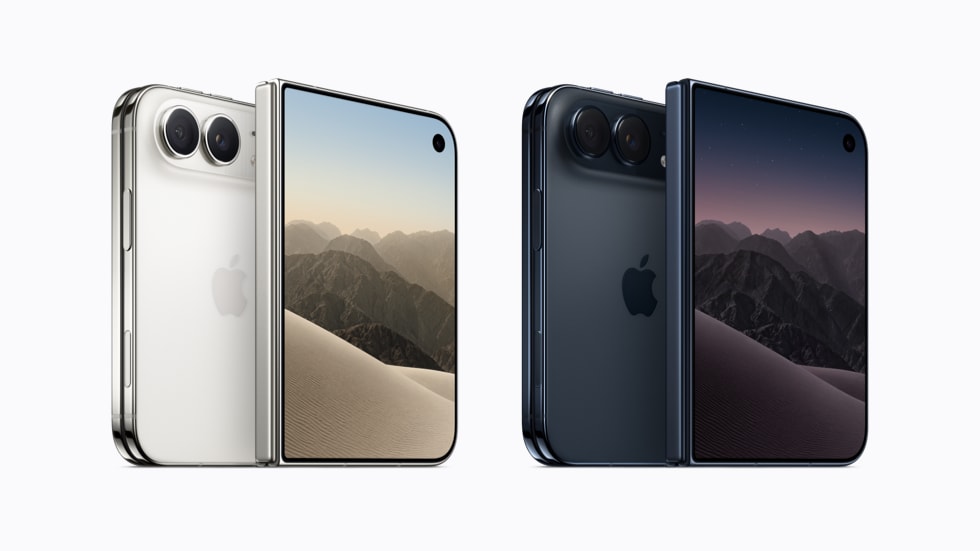 Image: Apple
So what exactly is the iPhone Duo?
Think of it like a small, very expensive book.
When it’s closed, you use it like a normal phone. There’s a 5.4-inch screen on the outside for your calls, WhatsApp, Instagram, transfers — everything you’d normally do one-handed.
When you open it, it unfolds into a 7.6-inch screen — basically a mini iPad in your pocket. That’s where you watch Netflix, play games, read documents, or run two apps side by side without squinting.
Apple says the outer screen gives you about 90% of the screen area of an iPhone 18 Pro, so it doesn’t feel like a compromise when it’s shut. And when open, it’s roughly 50% bigger than an iPhone 18 Pro Max.
The clever part? Both screens use the same shape, so when you fold or unfold, whatever you were doing just flows from one screen to the other without jumping around.
The features that actually matter
The screens are seriously good
Both displays are Super Retina XDR OLED — Apple’s best screen tech. They hit 3,000 nits of brightness, which in plain English means you can still read your phone under harsh Abuja afternoon sun without cupping your hand over it.
There’s also a matte, anti-glare finish that does two jobs: it kills reflections, and it helps hide the crease down the middle of the fold. Apple claims the crease is close to invisible.
No ugly notch on the inside
The front camera on the inner screen is hidden underneath the display until you actually need it. So when you’re watching a film, you get a clean, uninterrupted screen.
It’s fast — properly fast
The Duo runs the A20 Pro chip, the same one in the new iPhone 18 Pro, built on 2-nanometre technology. Apple added a vapour-chamber cooling system borrowed from its Mac laptops, so it doesn’t overheat and slow down during long gaming or video sessions.
Numbers Apple quoted: up to 35% better sustained performance than the iPhone 17 Pro, a CPU up to 20% faster and graphics up to 40% faster than last year’s chip.
Cameras with foldable-only tricks
You get a dual 48MP setup — a main camera and an ultra-wide — plus a 2x zoom cropped from the main sensor.
But the fun stuff is what folding unlocks:
- Duo Preview — the person you’re photographing can see themselves on the outer screen while you shoot. No more “let me see, let me see.”
- Smart Take — the phone automatically snaps the picture the moment everyone is actually posing properly.
- Kid Cue — plays Peanuts animations on the outer screen to get a toddler to look at the camera. Genuinely smart.
- Duo FaceTime — video calls that use both screens.
It also shoots 4K video at 120 frames per second.
Battery that lasts more than a day
Because the phone has two halves, Apple put a battery in each half and made them work as one. The claim: 31 hours of video on the big screen, 44 hours on the small one, and around 24 hours of normal mixed use.
Charging: 50% in about 20 minutes wired, or 30 minutes on MagSafe.
The new Siri finally arrives
The Duo ships with iOS 27 and the completely rebuilt Siri AI — Apple’s long-delayed answer to ChatGPT-style assistants. It rolls out in beta from 14 September, English first. Other AI features include a Siri Camera mode, smarter photo cleanup, and Safari alerts.
Built tough (they say)
- Grade 5 titanium frame with a mirror-polished finish
- Ceramic Shield 2 on the front — Apple claims 3x better scratch resistance
- IP68 water and dust resistance
- A hinge made of over 100 individual components, with magnets so it snaps shut properly
It takes a stylus
This is a first for iPhone. Apple Pencil support is coming later in 2026 — meaning you can write and draw directly on the big screen. Samsung actually dropped stylus support on its recent foldables, so Apple has a genuine edge here.
Colours
Two only: Star White and Night Sky (a deep blue).
The price. Brace yourself.
| Storage | US Price |
|---|---|
| 256GB | $1,999 |
| 512GB | $2,199 |
| 1TB | $2,599 |
| 2TB | $3,199 |
That makes the iPhone Duo the most expensive iPhone Apple has ever sold.
For comparison, the also-announced iPhone 18 Pro starts at $1,199 and the iPhone 18 Pro Max at $1,299.
When can you get it?
- Pre-orders: Friday, 16 October 2026
- On sale: Friday, 23 October 2026 in 70+ countries
- Second wave: 28 more countries from Friday, 30 October 2026
Now, the Nigeria question 🇳🇬
Here’s the part that matters most to us.
Nigeria is not on Apple’s confirmed first-wave list. Apple named the US, UK, Canada, Australia, China, India, Japan, UAE, Germany, France and Vietnam among the 23 October countries. Nigeria may fall into the unnamed 28-country second wave on 30 October — but that isn’t confirmed.
What will it cost here?
At today’s official rate of roughly ₦1,321 to the dollar, the base $1,999 model converts to about ₦2.64 million — before anything else. At parallel market rates, you’re looking at ₦2.77m–₦2.82m.
But that’s the conversion, not the price. Once you add customs duties (typically 20–35%), shipping, clearing and retailer margin, expect Nigerian street prices to land north of ₦3 million for the entry model. The 2TB version will be considerably higher.
Three things to watch before you buy:
- It’s eSIM-only. There is no physical SIM slot at all. MTN, Airtel and Glo all support eSIM now, but activation can still be slow and frustrating. Sort this out before you spend ₦3 million.
- Satellite SOS won’t work here. Apple’s emergency satellite features aren’t available in Nigeria.
- Watch out for fakes. New iPhones always arrive here through importers and resellers first. Stick to authorised dealers, and be very careful with “UK-used” listings and clone units. If you have family abroad, shipping through them remains the safest route.
If you’re spreading the cost, platforms like EasyBuy, CredPal and CDcare are the usual instalment routes — though at this price point, do the maths carefully.
How it stacks up against Samsung
Apple is late to this party. Samsung’s Galaxy Z Fold 8 launched back in August at $1,899 — a hundred dollars cheaper — with a 5.5-inch outer screen and a 7.6-inch inner screen. Huawei and Xiaomi also dropped foldables just two days ago, at $2,980 and $3,725 respectively.
But Apple has two advantages: the incoming Apple Pencil support (which Samsung dropped), and a wider outer screenthat behaves more like a proper phone when closed — one of the biggest complaints about earlier foldables.
Analysts at Counterpoint Research expect Samsung’s foldable market share to fall from 40% in 2025 to 32% in 2026, with Apple grabbing 25% almost immediately.
The catch (because there’s always one)
Let’s be honest about the trade-offs:
- The camera is a step down from the iPhone 18 Pro. There’s no dedicated zoom lens, and the 18 Pro’s new variable-aperture main camera is better. Photography critics have already pointed this out sharply.
- No Face ID. You get Touch ID in the side button instead.
- Durability is unproven. Foldables have a history of hinge and screen problems. Apple reportedly shelved this project years ago after a test panel failed. Wait for independent reviews in late October before committing.
- Supply is expected to be tight at launch.
- Wall Street wasn’t blown away either — Apple’s shares dipped about 1.9% during the afternoon.
The verdict
The iPhone Duo is the most interesting thing Apple has made in years. It’s also the most expensive, and it asks you to accept a weaker camera and unproven durability in exchange for a screen that unfolds.
If you want the best iPhone camera, buy the iPhone 18 Pro and save yourself $800.
If you want the future in your pocket and you can absorb a ₦3 million-plus hit — this is it.
Either way, one thing is settled: the foldable phone is no longer a niche experiment. Apple just made it mainstream.
What do you think — is a folding iPhone worth ₦3 million in this economy? Drop your thoughts in the comments.
Follow digitaleta.com for updates as Nigerian availability and pricing are confirmed.


Discussion
No comments yet.